Television addiction
Charlie and the Chocolate FactoryTelevision addiction is the defining condition of Mike Teavee, the nine-year-old boy whose identity is introduced through an almost total dependence on the screen. He does not merely enjoy television: it occupies his household, commands his attention, shapes his speech, and becomes the standard by which he judges reality. His later encounter with Television Chocolate makes that dependence physically consequential, shrinking him into a tiny figure while leaving his craving for television intact.
Definition and First Presentation
Television addiction appears first as a compressed identity: Mike Teavee is described as a boy who does nothing but watch television. The formulation leaves little room for any competing activity or interest. Whereas the other children are defined by spoiled behavior, constant gum chewing, or excessive eating, Mike is defined by a medium that has displaced ordinary childhood experience. His name and characterization become inseparable from the apparatus before he has even entered the factory.
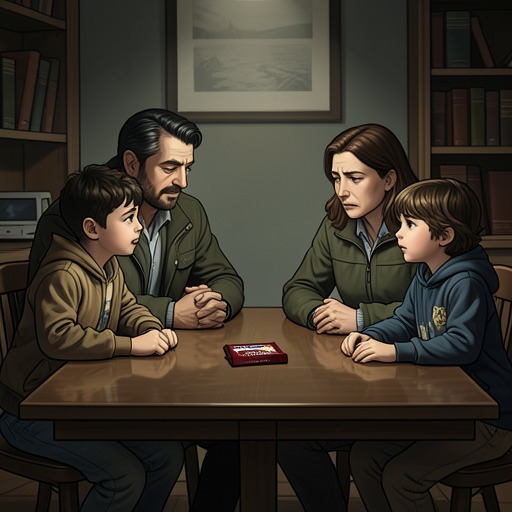
The newspaper account of the fourth Golden Ticket makes the condition visible in domestic space. The Teavee household is filled with visitors celebrating Mike's discovery, yet Mike experiences their presence only as an interruption. He angrily demands to know why they cannot see that he is watching television and wishes they would stop disturbing him. The Golden Ticket, which should redirect his attention toward a rare public event, initially has no power against the screen: even winning access to Willy Wonka's Chocolate Factory is less immediate to him than the program already playing.
Habits, Language, and Violent Fantasy
Mike is seated before an enormous television set with his eyes fixed on the screen. The scale of the set emphasizes the imbalance between child and machine: the screen is not a minor object in the room but a dominant presence before which he is positioned. His viewing is accompanied by a costume of imitation. Eighteen toy pistols of different sizes hang from belts around his body, and he repeatedly jumps up to fire several rounds from them while watching a film in which one group of gangsters attacks another with machine guns.
The toys convert viewing into bodily rehearsal. Mike does not remain physically still in any meaningful sense; the program supplies movements, weapons, and scenarios that he performs in miniature. Yet the performance remains derivative, organized by images received from the screen. His body copies televised violence while his imagination treats the gangsters as models of an attractive life. He praises shooting, knives, and knuckledusters and declares that he would give anything to be doing such things himself. Television therefore functions for him not simply as entertainment but as a source of aspiration and a vocabulary for desire.
His speech repeats the judgments supplied by the programs. He watches every day, including shows he considers poor when they lack shooting, because his commitment is not selective in the ordinary sense: television itself is the object of attachment. Violent gangster programs are his favorites, but the deeper compulsion is the need to keep watching. The family and reporters cannot enter his attention without being treated as obstacles, while his own declarations become increasingly excited and repetitive. The result is a portrait of appetite transferred from food to images, with the screen serving as the object that must continually be consumed.
The Factory's Television Chocolate
Willy Wonka's Television Chocolate brings Mike's private habit into direct contact with the factory's experimental machinery. In the Testing Room for the invention, Wonka presents the product as a new form of chocolate that works by television. Wonka explains that he dislikes television himself and regards it as acceptable only in small doses, while children, in his view, want to sit before the screen all day staring at it. Mike immediately identifies himself with that description, openly acknowledging that the warning applies to him.
The invention is designed around the same process that makes television powerful: a large camera breaks an image into countless tiny pieces, sends them through space, and reconstructs them inside a receiving set. Wonka reverses that movement so that a chocolate bar can be transmitted through the television and reassembled on the other side. When the bar arrives, it has become smaller during the journey, but Wonka insists that it remains the same bar and urges the observers to eat it. The experiment thus turns the screen from a place where images arrive into a channel through which a physical product can be delivered.
Wonka imagines extending the system across the country. A commercial would appear on a household screen, instructing viewers to eat Wonka's chocolates and then take one directly from the television. The fantasy is both technological and commercial: television would no longer merely advertise chocolate but would place the chocolate in the viewer's hand. The medium that absorbs Mike's attention becomes, in Wonka's vision, an instrument for distributing desire and merchandise. The scene therefore places compulsive spectatorship beside an ambitious system of consumption, making the distinction between entertainment and advertising increasingly unstable.
Physical Consequence and Refusal to Change
Mike insists on being sent through the television himself. The experiment produces a dramatic value shift: what seemed to promise instant access instead results in bodily reduction. He emerges tiny enough to stand in his mother's hand. His parents fear that he will be trodden on or squashed and believe that his size will prevent him from doing anything, but Mike immediately identifies one activity that remains available to him: watching television.
The consequence exposes the depth of the addiction. Physical transformation has altered Mike's scale but not his governing desire. Even after the machine has made him vulnerable and dependent on others, he treats continued viewing as the essential condition of his life. His father responds by threatening to throw the television set out of the window, declaring that he has had enough of television. That threat is not presented as a successful cure. Instead, it triggers Mike's terrible tantrum: he jumps on his mother's palm, screams, tries to bite her fingers, and repeatedly demands to watch television. His reduced body makes the compulsion more grotesque and more visible, but it does not diminish it.
The family is forced to carry the consequence of the experiment. Mike's father stuffs the tiny boy into the breast pocket of his jacket and places a handkerchief over him while squeals and yells come from inside and the pocket shakes with his attempts to escape. Mrs Teavee asks how he can be made to grow, but the immediate scene offers no restoration. The machine has not simply transported a child; it has revealed that the behavior associated with television is more persistent than the body that performs it.
Moral and Narrative Significance
The Oompa-Loompas' response places Mike's condition within the factory's recurring pattern of exposure and judgment. After the children who have behaved badly disappear from the tour, Willy Wonka remarks that two naughty little children are gone and three good little children remain. Mike's fate belongs to this system of consequence, in which a child's dominant habit becomes the basis for a physical reversal. The factory does not treat television addiction as an abstract social problem; it gives the habit a concrete, humiliating result.
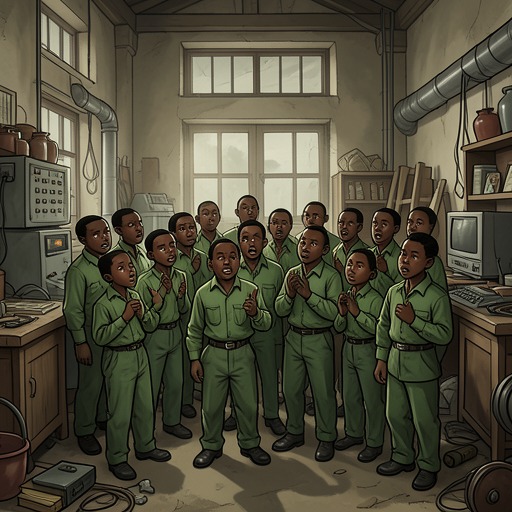
The song that follows states the lesson as a general rule about children: the most important thing learned so far is never to let them watch television. Its repeated emphasis turns a particular punishment into a broad warning. Yet the story's treatment is more complicated than a simple rejection of technology. Wonka's own invention depends on television and promises to make chocolate instantly available to people sitting at home. The same medium is represented as an absorbing danger when it governs a child and as a brilliant commercial technology when controlled by the factory. That contrast creates the central tension of television addiction: the screen can be a device for connection and distribution, but it can also become an environment that replaces attention, imagination, and choice.
The final note concerning Mike refuses a neat recovery. The Oompa-Loompas express regret that they will simply have to wait and see what becomes of him. The unresolved ending is significant because Mike's addiction has not been overcome; it remains an open prospect, carried forward in the child's repeated demand to keep watching. Television addiction thus functions as both character trait and cautionary structure. It explains Mike's introduction, governs his behavior during the factory tour, produces his transformation, and survives that transformation as the one desire he refuses to surrender.